The Origin of Apple Fruit: From Central Asia to the Himalayan Orchards
The apple is one of the world's most familiar fruits, enjoyed fresh, cooked, juiced and preserved in countless ways. But where did apples originate?
The Origin of Apple Fruit
The apple is one of the world's most familiar fruits, enjoyed fresh, cooked, juiced and preserved in countless ways. But where did apples originate?
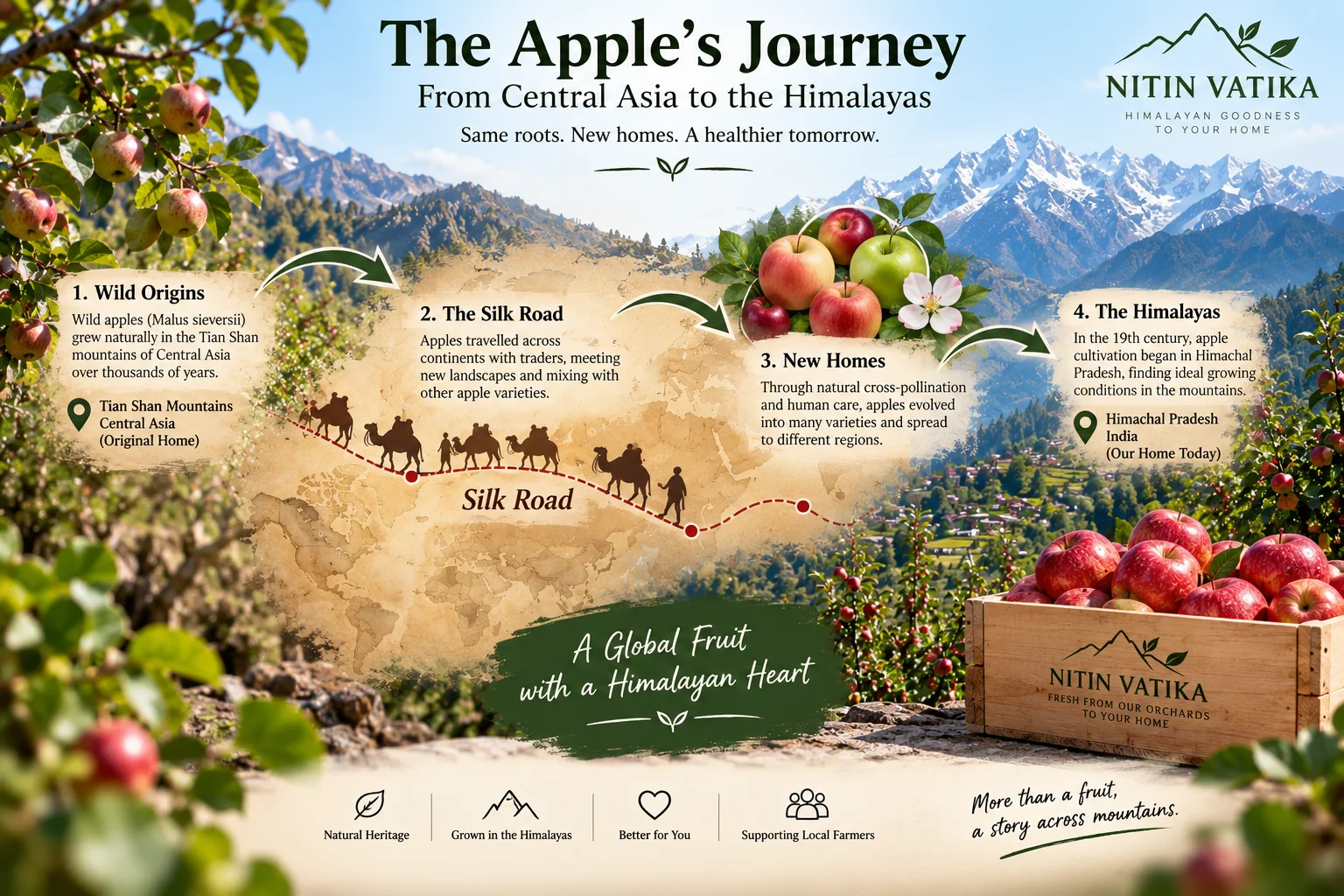
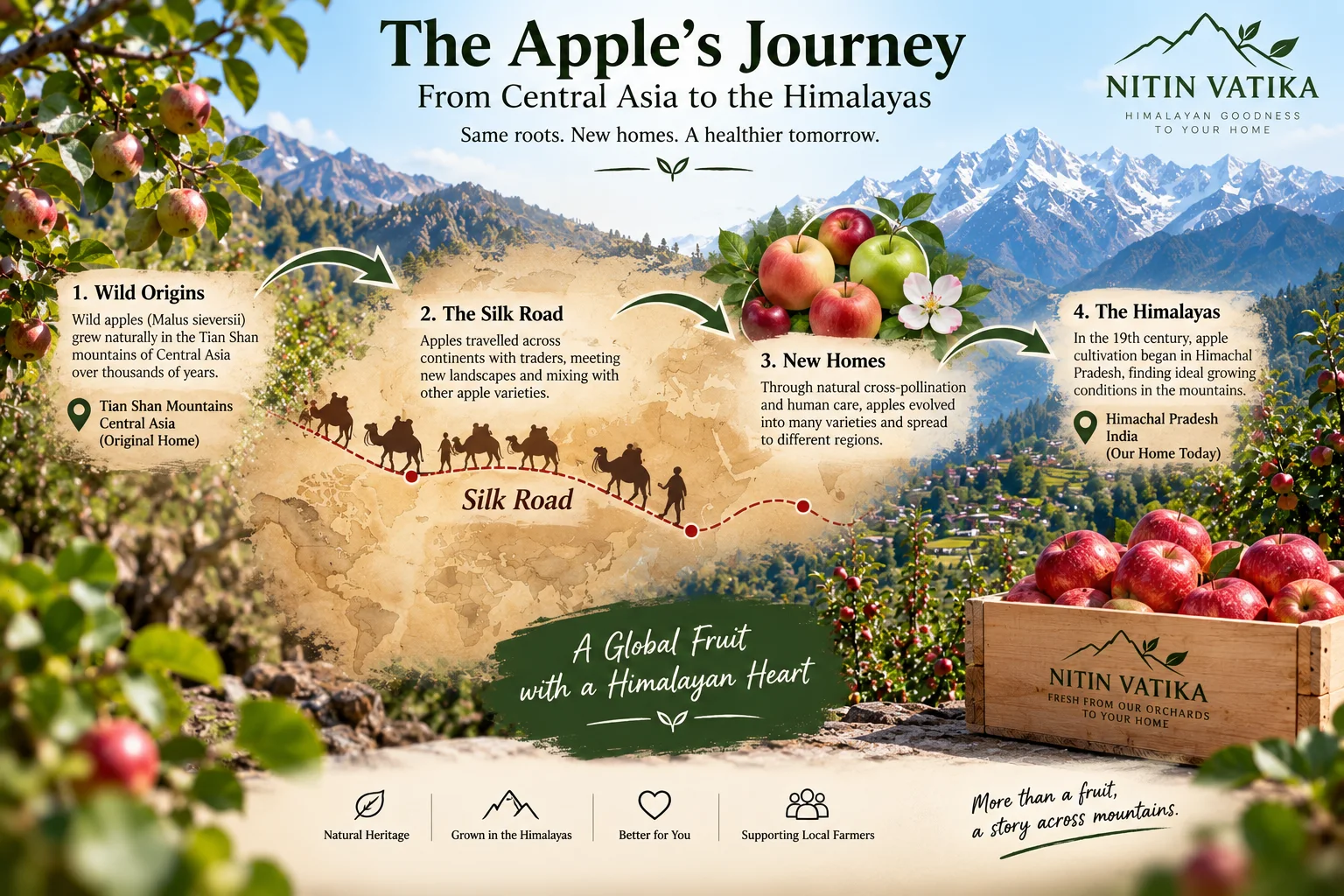
The story of the apple begins thousands of years ago in the mountains of Central Asia, particularly around the Tian Shan region. Long before modern varieties such as Red Delicious and Golden Delicious became popular, wild apple trees were growing naturally across the forests and valleys of this region.
One of the most important ancestors of today's cultivated apple is Malus sieversii, a wild apple species native to Central Asia.
From these ancient forests, apples began a remarkable journey across continents. Through natural cross-pollination, human cultivation and the movement of people along ancient trade routes, the apple gradually developed into the diverse fruit we know today.
And eventually, apples found a natural home in another great mountain region: the Himalayas.
Where Did Apples Originate?
The modern cultivated apple, Malus domestica, is primarily associated with Central Asia, especially the Tian Shan mountain region.
Wild populations of Malus sieversii found in areas of present-day Kazakhstan and neighbouring Central Asian regions contain extraordinary genetic diversity. Some wild trees produce small and sour fruits, while others produce apples that are surprisingly sweet and large.
This diversity was extremely important in the evolution of the cultivated apple.
Over thousands of years, people selected and propagated apple trees with desirable characteristics such as:
- Better taste
- Larger fruit
- Improved texture
- Attractive colour
- Better storage qualities
- Suitability for different climates
Through this long process, the wild apple gradually became the cultivated apple found in orchards around the world.
Malus sieversii: The Wild Ancestor of Modern Apples
If you trace the family history of today's cultivated apple, Malus sieversii is one of the most important names you will encounter.
This wild apple grows naturally in Central Asia and is considered the principal ancestor of the cultivated apple.
What makes it particularly fascinating is the amount of natural variation found among these wild trees.
Different trees can produce fruit with very different characteristics. This natural genetic diversity provided an enormous resource for the development of cultivated apples.
In other words, the modern apple did not appear suddenly.
It is the result of a very long process involving wild apple populations, natural evolution, cross-pollination, human selection and cultivation.
The Silk Road and the Spread of Apples
The history of apples is closely connected with the ancient Silk Road.
The Silk Road was a network of trade routes connecting Central Asia with regions of the Middle East, Europe and Asia. Traders and travellers transported much more than silk and valuable goods. Plants, seeds, fruits, animals and agricultural knowledge also moved between communities.
Apples were among the crops that travelled along these routes.
As apples moved westward and encountered other wild apple species, cross-pollination introduced additional genetic diversity. Over generations, these interactions helped shape the cultivated apple.
This means the apple we eat today is essentially the product of a thousands-of-years journey across Eurasia.
How Did Wild Apples Become Modern Apples?
The transformation from wild apple to cultivated fruit happened gradually.
Early communities would have encountered wild apple trees and naturally noticed that some produced better fruit than others.
A particularly sweet or large apple could be much more desirable than a small, bitter one.
People could then save seeds or propagate desirable trees.
Over many generations, farmers increasingly selected trees with useful characteristics.
Another important development was grafting.
Grafting allowed growers to reproduce desirable apple varieties more consistently. Instead of relying entirely on seeds—which can produce genetically different trees—growers could use plant material from a known variety.
This helped preserve and spread particular apple varieties.
How Did Apples Reach India?
The apple has ancient origins in Central Asia, but commercial apple cultivation in India developed much later.
The Himalayan region proved particularly suitable for temperate fruit cultivation.
Himachal Pradesh eventually became one of India's best-known apple-growing regions.
Historical accounts place the development of apple cultivation in Himachal Pradesh in the 19th century. Early orchards were established in areas such as Kullu, while later developments around Kotgarh helped establish apple cultivation as an important agricultural activity.
Samuel Evans Stokes, later known as Satyanand Stokes, played an important role in the development of apple cultivation around Kotgarh and introduced commercially important varieties.
From these early beginnings, apple cultivation expanded throughout many parts of Himachal Pradesh.
Why Are Apples Grown in the Himalayas?
Apples are temperate fruits and generally require specific climatic conditions to develop properly.
The Himalayan landscape offers many locations with suitable combinations of:
- Cool winters
- Appropriate chilling conditions
- Mountain elevations
- Seasonal temperature changes
- Sunlight
- Suitable soils
- Natural slopes and varied microclimates
However, growing good-quality apples is not simply about altitude.
Apple quality depends on many factors, including variety, weather, soil, water, orchard management, flowering conditions and harvest timing.
For an orchardist, the growing season is a continuous process of observing the trees and responding to changing conditions.
The Importance of Harvesting Apples at the Right Time
One of the most important stages in apple production is harvest.
An apple continues to change as it develops on the tree. Harvest timing can influence its:
- Sweetness
- Firmness
- Colour
- Flavour
- Keeping quality
- Overall eating experience
Weather also plays an important role around harvest time.
For this reason, responsible orchard harvesting is not simply about choosing a date on the calendar. Orchardists observe the fruit and the conditions before deciding when it is ready.
At Nitin Vatika, we believe that the journey from orchard to customer begins with careful attention to the fruit while it is still growing.
From Himalayan Orchards to Your Home
The story of the apple stretches across thousands of years.
It began with wild apple populations in the mountains of Central Asia. It continued through ancient trade routes, natural cross-pollination, human selection and generations of cultivation.
Eventually, apples became established in mountain regions around the world—including the Himalayas.
Today, Himalayan apples are an important part of the agricultural landscape of Himachal Pradesh.
At Nitin Vatika, we are proud to be part of this continuing story.
Our connection to apples is not simply about selling fruit. It is about the orchard, the harvest and the people who carefully grow the crop.
When you receive apples from a Himalayan orchard, you're receiving the result of a journey that began thousands of years ago.
From the wild forests of Central Asia to the Himalayan orchards of Himachal Pradesh—the story of the apple continues.
The Apple: A Journey Across Mountains and Generations
The next time you hold an apple, consider how extraordinary its history really is.
Its ancestors grew wild in Central Asian mountains.
People discovered and selected better fruits.
Seeds and plants travelled across ancient trade routes.
Different apple populations mixed and evolved.
Farmers developed new varieties.
And eventually, apples became an important crop in Himalayan regions such as Himachal Pradesh.
The apple in your hand is therefore much more than a simple fruit.
It is the result of thousands of years of nature, farming and human curiosity.
At Nitin Vatika, we are happy to continue that journey—one Himalayan apple at a time.